

Europe steps out of America’s shadow, as Bharat moves to centre of global economy
Potential EU–India agreement will create 2-bn-person market, representing nearly a quarter of global GDP
Europe steps out of America’s shadow, as Bharat moves to centre of global economy
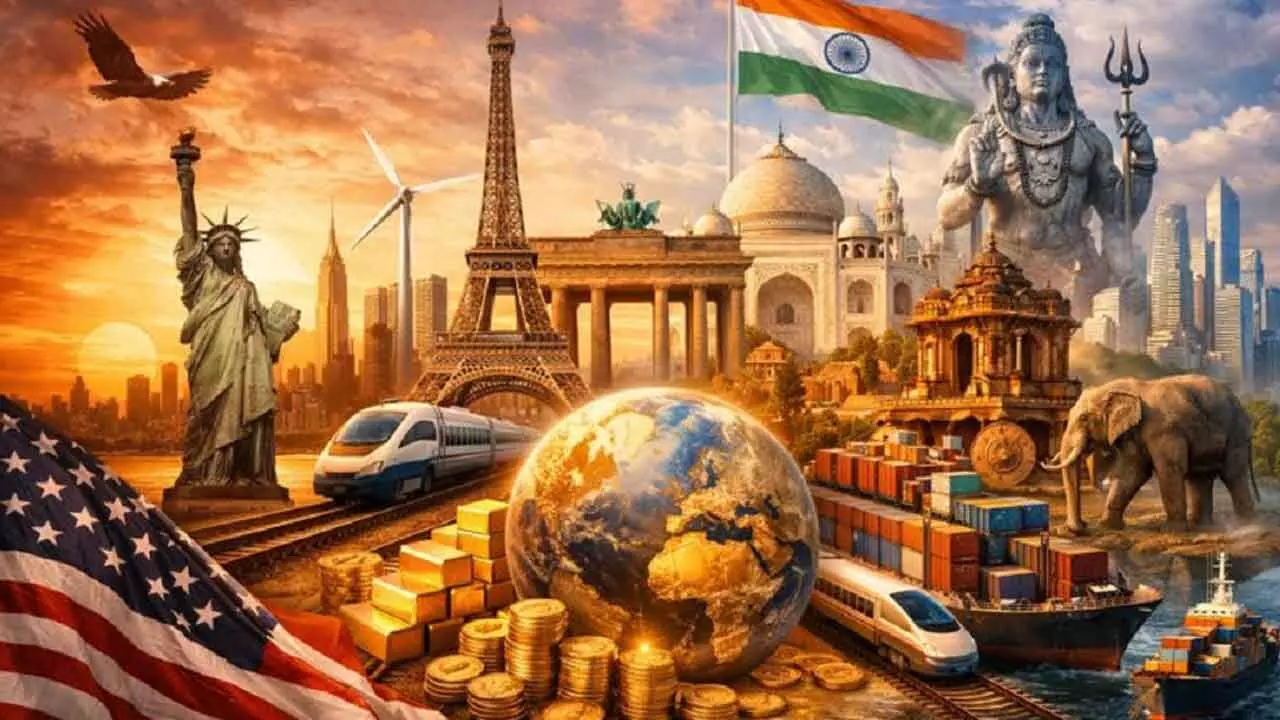
For nearly eight decades after World War II, Europe lived under a comforting assumption: that the Atlantic alliance was permanent, predictable, and ultimately indivisible. That assumption has now expired.
At the World Economic Forum 2026, Ursula von der Leyen, President of the European Commission, delivered what may eventually be remembered as Europe’s most consequential geopolitical speech since the Cold War, not because it attacked the United States, but because it calmly declared Europe’s intention to outgrow its dependence on it. For Bharat, this shift is not abstract geopolitics. It is a once-in-a-generation economic opening, stretching from farms to factories, ports to power grids, and capital markets to defence supply chains.
Repeat of the geoeconomic confrontation
Ursula began her speech at Davos by reminding the world of the first Geoeconomic confrontation unleashed in 1971, when the United States unilaterally delinked the dollar from gold—the so-called Nixon Shock. The collapse of the Bretton Woods system was not merely a monetary event; it was a geopolitical wake-up call. Europe discovered overnight that its prosperity rested on decisions taken in Washington.
Thus, her message was unmistakable: Strategic dependence is always exposed during geopolitical shocks. What the dollar shock did in 1971, Donald Trump’s tariff war is the second Geoeconomic confrontation the world is experiencing. Trump’s second term has become a reminder that alliances, when overly asymmetric, can turn transactional. And it seems Europe has woken up to this reality and drawn a clear conclusion: the old order will not return, and waiting for it to do so is not a strategy.
Europe’s pivot: From Atlantic certainty to global optionality
Von der Leyen’s speech returned again and again to one core idea: European independence—not isolation, not neutrality, but the freedom to make its own choices. She said this independence would rest on four economic pillars: diversifying trade beyond the West, securing energy and raw materials, integrating capital markets, and building defence and technology strength. None of these goals, she stressed, can be achieved without working closely with fast-growing economies of the Global South. Among them, Bharat stands out as a uniquely important partner.
The mother of all deals
The EU–Mercosur trade agreement, finalised after 25 years and signed in early 2026, creates one of the world's largest free trade areas, covering over 700 million people. It eliminates tariffs on over 90 per cent of goods, boosting European exports (cars, machinery) and South American agricultural products (beef, soy). The agreement spans 31 countries and represents nearly 20 per cent of global GDP, signalling Europe’s shift away from tariff-driven economic nationalism toward scale, sustainability, and resilient supply chains. Yet it was a potential trade agreement with Bharat that von der Leyen described—without exaggeration—as “the mother of all deals.”
A potential EU–India agreement would create a 2-billion-person market, representing nearly a quarter of global GDP. According to Ursula, the proposed agreement would offer Europe a first-mover advantage in the fastest-growing major economy. For Bharat, the implications go far beyond exports.
From food security to digital infrastructure
The EU is under pressure to secure its food supply chains while meeting climate commitments and reducing dependence on geopolitically risky regions. Bharat’s strengths align perfectly with Europe's needs. India has a vast and diversified agricultural base. In the past decade, initiatives such as Startup India, Make in India and others have led to a revolution across sectors; however, the agricultural sector and digital public infrastructure have experienced rapid adoption and disruption. As Europe seeks sustainability over exploitation, Bharat’s ability to provide traceable, climate-compliant agricultural supply chains turns farming into strategic infrastructure rather than a welfare sector. This is not about exporting wheat or rice alone—it is about processed foods, agri-inputs, bio-energy crops, precision farming tools, and climate-resilient seeds.
Europe’s de-risking is Bharat’s opportunity
Europe’s stated goal is “de-risking,” not decoupling, reducing exposure to China and other unpredictable partners, which means the United States. This supply-chain reset opens a major opportunity for Bharat to attract manufacturing relocation, plug into European industrial value chains, and emerge as a trusted hub for clean manufacturing in electronics, machinery, and auto components.
Von der Leyen’s focus on AI factories, gigafactories, batteries, and advanced industrial equipment aligns closely with New Delhi’s production-linked incentives and infrastructure push. Unlike the Chinese model, Europe is seeking resilience without dependence, and Bharat offers scale without strategic coercion.
Capital is looking for a home, and Bharat is on the map
One of the speech’s most technical, but important, announcements was Europe’s push to build a Savings and Investment Union, integrating its fragmented capital markets. Why does this matter to India? Because Europe is sitting on vast pools of capital seeking Growth, Stability, and Long-term returns, as Europe becomes more internally confident, it will deploy capital externally with strategic intent. Bharat, with its improving regulatory clarity and massive infrastructure pipeline, becomes a natural destination for European patient capital, especially in renewables, logistics, urban infrastructure, and agri-processing.
Energy and India opportunity
Europe’s energy independence push is rooted in nuclear, renewables, and grid integration. This opens doors for Indian firms involved in solar and wind manufacturing and those offering Grid equipment. Bharat’s scale can help Europe bring down costs, while Europe’s technology and capital can help India climb the value chain. This is not charity—it is mutual strategic insurance.
Value chain partner
Perhaps the most radical shift is Europe’s comfort with defence industrialisation. An €800-billion defence spending surge, the rise of defence-tech unicorns, and the explicit linking of economy with security mark the end of Europe’s post-war military hesitation.
For Bharat, this matters because Europe will look to diversify the defence supply chain, not just to a reliable partner but to one that can add value to the partnership through research, co-development, and precision manufacturing. The two partners could also explore Dual-use technologies in areas such as AI, drones, and surveillance. Bharat is no longer merely a buyer; it can be a co-producer as a “Value chain partner.”
The historical break: EU seeks freedom
Since World War II, Europe has largely moved in step with the United States, whether at the United Nations, during major conflicts such as the second Iraq War, through military alliances like NATO, or in nuclear and security arrangements. This alignment brought stability and prosperity, but it also limited Europe’s ability to act independently on the world stage.
President Trump’s second term stripped away the illusion that such dependence could last forever without cost. President Ursula von der Leyen made it clear that Europe has now accepted a hard truth: strategic adulthood can no longer be postponed, even if it comes with difficult choices.
What does this shift mean for India? Bharat is no longer waiting outside Europe’s door. Europe is turning to India out of necessity, not as a symbolic diversification exercise. For New Delhi, this is a rare strategic moment to negotiate firmly but pragmatically, link trade access to technology transfer, align agriculture, manufacturing, and energy policies with global supply chains, and, above all, treat Europe as a long-term strategic economic partner rather than a legacy export market.
The board has shifted
Ursula von der Leyen’s speech was not anti-American. It marked Europe’s quiet break from the post–World War II habit of strategic dependence on the US. Europe is repositioning itself for a permanently multipolar world and, in that process, elevating Bharat from an emerging economy to a cornerstone of its global strategy.
For India’s farms and factories, this could be the most consequential geopolitical shift since liberalisation. The world has changed. Europe has recognised it. Now, it is for Bharat to seize the moment.
(The author is Founder of My Startup TV)





